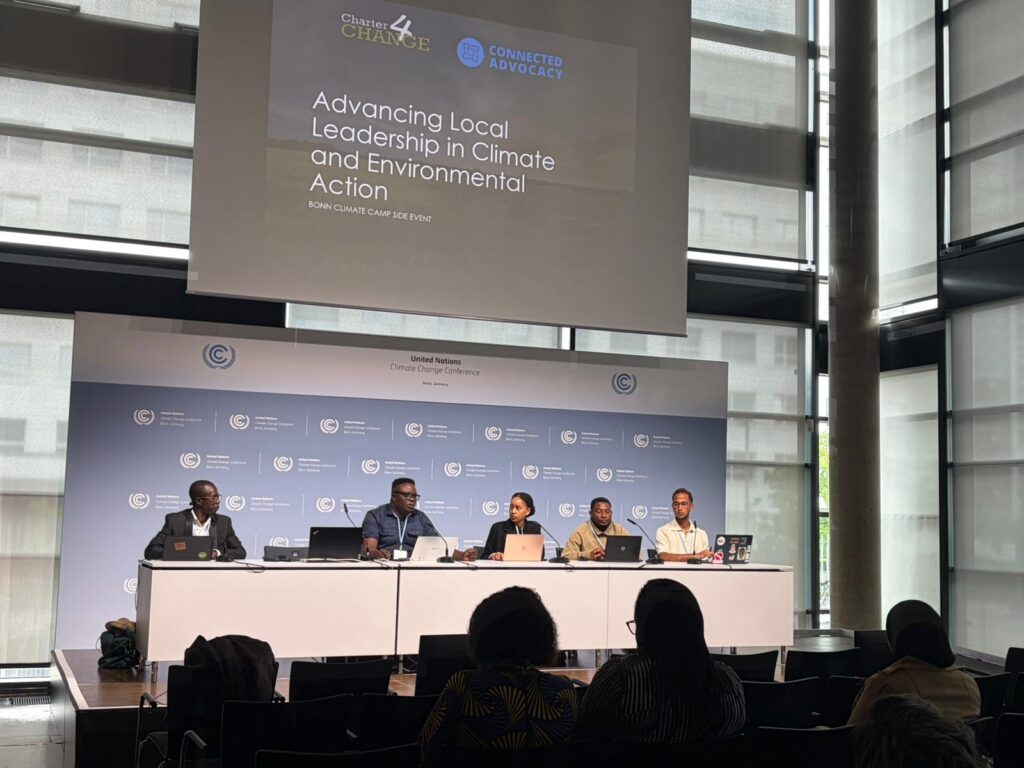
Connected Advocacy and (C4C) Climate & Environment Working Group organized a side event at the UNFCCC SB64 Bonn Climate Conference at the World Climate Conference in Bonn, Germany.
Theme: Strengthening Collaboration on Climate, Humanitarian, and Environmental Action: Closing the Gaps for Implementing Contextual Localization Work Programs Nexus Between What Works Well and How Reporting Period: 9–12 June 2026. Background As climate change, environmental degradation, and humanitarian crises increasingly intersect, there is growing recognition that effective and sustainable solutions must be locally led and contextually grounded. Despite global commitments to localization, many local organizations continue to face barriers in accessing decision-making spaces and climate financing opportunities. The participation of Connected Advocacy at SB64 sought to contribute to ongoing global conversations by highlighting community perspectives and promoting practical pathways for operationalizing localization commitments within climate, humanitarian, and environmental action.
Objectives
The participation aimed to:
- Amplify the voices and priorities of local and grassroots actors in global climate discussions.
- Promote local leadership in climate adaptation, resilience building, environmental governance, and humanitarian response.
- Advocate for increased direct financing and equitable partnerships for local organizations.
- Strengthen collaboration among climate, humanitarian, and environmental stakeholders.
- Generate actionable recommendations for contextual localization work programs.
- 2.Multistakeholder Dialogue on Localization of Climate-Humanitarian and Environmental Action Date: 10 June 202 Venue: Special Event Room, World Conference Center Bonn (WCCB) The dialogue brought together representatives from civil society, humanitarian agencies, climate networks, local organizations, and development partners to assess progress and challenges in implementing localization commitments.Key Discussion Areas
- Persistent localization implementation gaps.
- Limited access to direct climate and humanitarian financing.
- Capacity strengthening and equitable partnership models.
- Contextual approaches to localization work programs.
- Cross-sector collaboration among climate, humanitarian, and environmental actors.
Key Messages
Participants highlighted the need to move beyond policy commitments toward practical implementation mechanisms that ensure resources, authority, and decision-making power are shared more equitably with local actors
- 3.Press Conference: Voices from the GroundDate: 11 June 2026
Venue: Bonn Press Conference Centre
The press conference officially launched the C4C Climate and Environment Working Group Memorandum and Community-Based Localization Assessment Report, which was broadcast through the UNFCCC media platform and shared with media partners and stakeholders.
Key Highlights
- Presentation of localization priorities identified by community and local actors.
- Recommendations for increasing direct funding allocations to local organizations, including a target of at least 25 percent of climate and humanitarian financing reaching local actors.
- Discussion of accountability mechanisms for tracking localization commitments.
- Policy recommendations for inclusive climate, humanitarian, and environmental governance.
Significance
The launch provided an opportunity to elevate grassroots perspectives within global policy discussions and contribute evidence-based recommendations for strengthening localization implementation.
- Challenges and Gaps Identified Several challenges were encountered during the engagement: 1.Limited preparation time for mobilization and stakeholder coordination. 2.Distance between event venues, affecting participation and logistics. 3.Visa restrictions and travel barriers that limited participation by grassroots and frontline community representatives. 4.Insufficient financial resources to support wider participation of local actors. 5.Continued underrepresentation of local organizations in international climate policy processes.
- Key Outcomes
The participation achieved several important outcomes:
- Increased visibility of localization priorities within climate, humanitarian, and environmental discussions at SB64.
- Strengthened collaboration among local actors, civil society organizations, and international partners.
- Amplified grassroots perspectives and community voices in policy dialogues.
- Reinforced recognition of local leadership as central to effective climate action and resilience building.
- Generated practical recommendations for contextual localization implementation.
- Expanded engagement of youth-led and grassroots organizations within the C4C Climate & Environment Working Group.